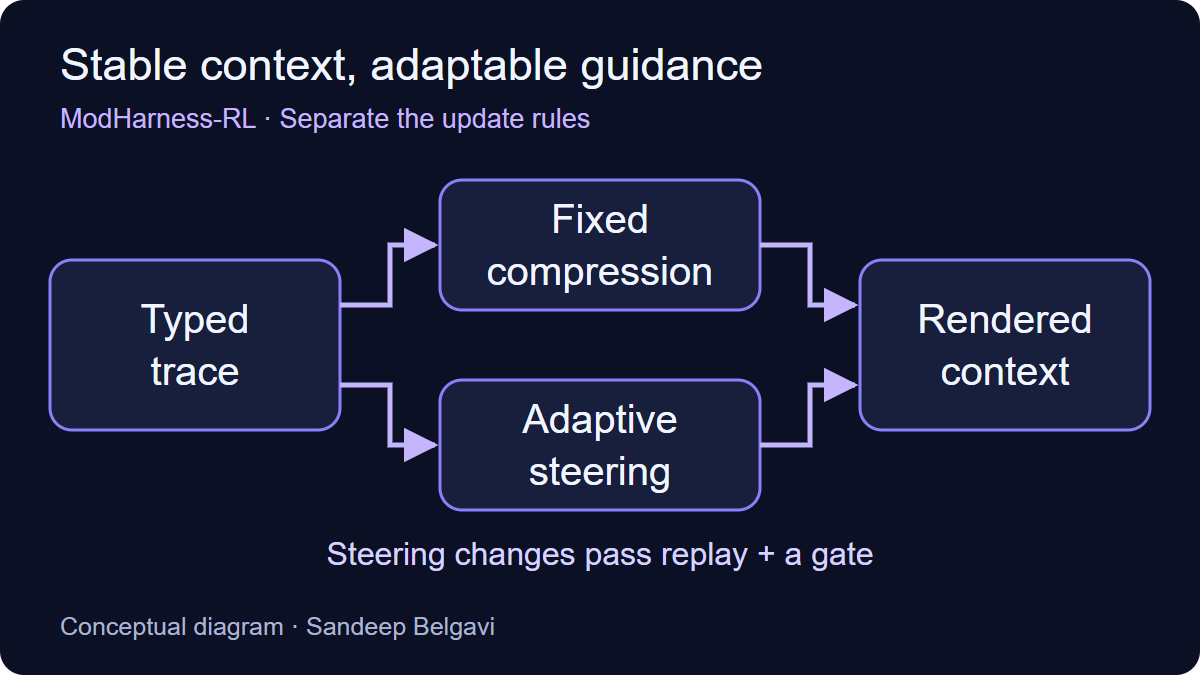
ModHarness-RL asks which parts of an agent's surrounding software should adapt during reinforcement learning. The preprint was submitted November 13, 2026 and appeared in the November 16 arXiv research announcements. This review covers that paper; it does not announce a released library. The author project page still marked code as pending when accessed.
Separate the parts that adapt
The method represents interaction history as typed state and learns executable programs for compression and steering. It fits compression before reinforcement learning and freezes it. Steering can evolve during training, with candidates replayed against earlier trajectories and checked on held-out tasks. Tools and action formatting stay fixed.
That separation suggests a useful engineering principle: preserve a stable observation contract while testing changes to guidance. If every layer changes together, an improved score is hard to attribute. A different context view could expose missing evidence, a steering rule could alter search order, or a policy update could change tool choices. Keeping those interventions identifiable makes a failed change easier to diagnose.
A replay gate needs evidence beyond repetition
Consider an original synthetic code-search exercise. A repository contains a parser, a normalizer and a test fixture. An agent repeatedly reads the normalizer even though the failing assertion points toward the parser. A candidate steering rule detects repeated reads and suggests inspecting an unvisited dependency. This is a proposed exercise, not an experiment performed for this review.
A count of repeated calls is insufficient to accept the rule. An agent that stops searching immediately also repeats nothing. The gate should score whether it identifies the relevant function, whether the supporting trace actually contains that function, and how often the rule diverts a correct search. Keep separate tasks where another read is justified because an earlier tool response was truncated. Those cases prevent a repetition detector from becoming a blanket ban.
Retain the untouched trace alongside the compressed context. In this proposed design, each accepted rule receives a version and a reference to its evaluation cases. Record the policy checkpoint, compressor version, steering version and tool schema together. This is an editorial design suggestion, not an implementation feature established by the paper.
Read the localization metric correctly
The authors report 14–24% relative improvement over their fixed-harness baseline on CodeSearch. That score measures localization through F1 over file, module and entity names; it is not the percentage of issues repaired. Full comparative evaluation concentrates on CodeSearch, while other environments examine component behavior. These are author-reported results, not independently reproduced measurements.
The distinction affects the acceptance test. Locating a relevant function and changing it correctly are separate outcomes. A useful evaluation record would preserve both if a later system adds patch generation. Otherwise a promising localization result could silently acquire a stronger meaning when reused in a repair workflow. Relative improvement should also remain relative: it is not the same quantity as percentage-point gain.
Compress with recoverable evidence
The project's example shortens older long file reads while retaining structural lines; recent turns and shorter reads remain intact. Executing the resulting program does not require another model invocation. For a teaching implementation, keep a pointer from each shortened observation to its full original. An agent or evaluator can then distinguish information removed from the view from information that was never obtained.
A proposed failure case is a bug hidden in a line the compressor omits. The correct response is to recover the original observation or issue a focused read, not to declare the compressor harmless because most tasks still pass. Test that recovery path with a deliberately placed synthetic marker and inspect the resulting evidence trail.
The limits of learned rules
The paper notes that a limited gate can accept worse programs, deterministic rules miss some semantic failures, and its program creator uses proprietary GPT-5-mini. Pending code also limits immediate reproduction. Treat the study as evidence for a specific adaptation strategy. Before adopting a similar design, establish whether the evaluation can reject a rule that looks efficient while hiding the information needed to finish the task.
Sources accessed November 16, 2026. Views are my own and do not represent any employer, past or present.
Sources and evidence
Version context compression and steering separately, preserve recoverable traces, and accept a learned rule on task evidence rather than on fewer repeated calls alone.