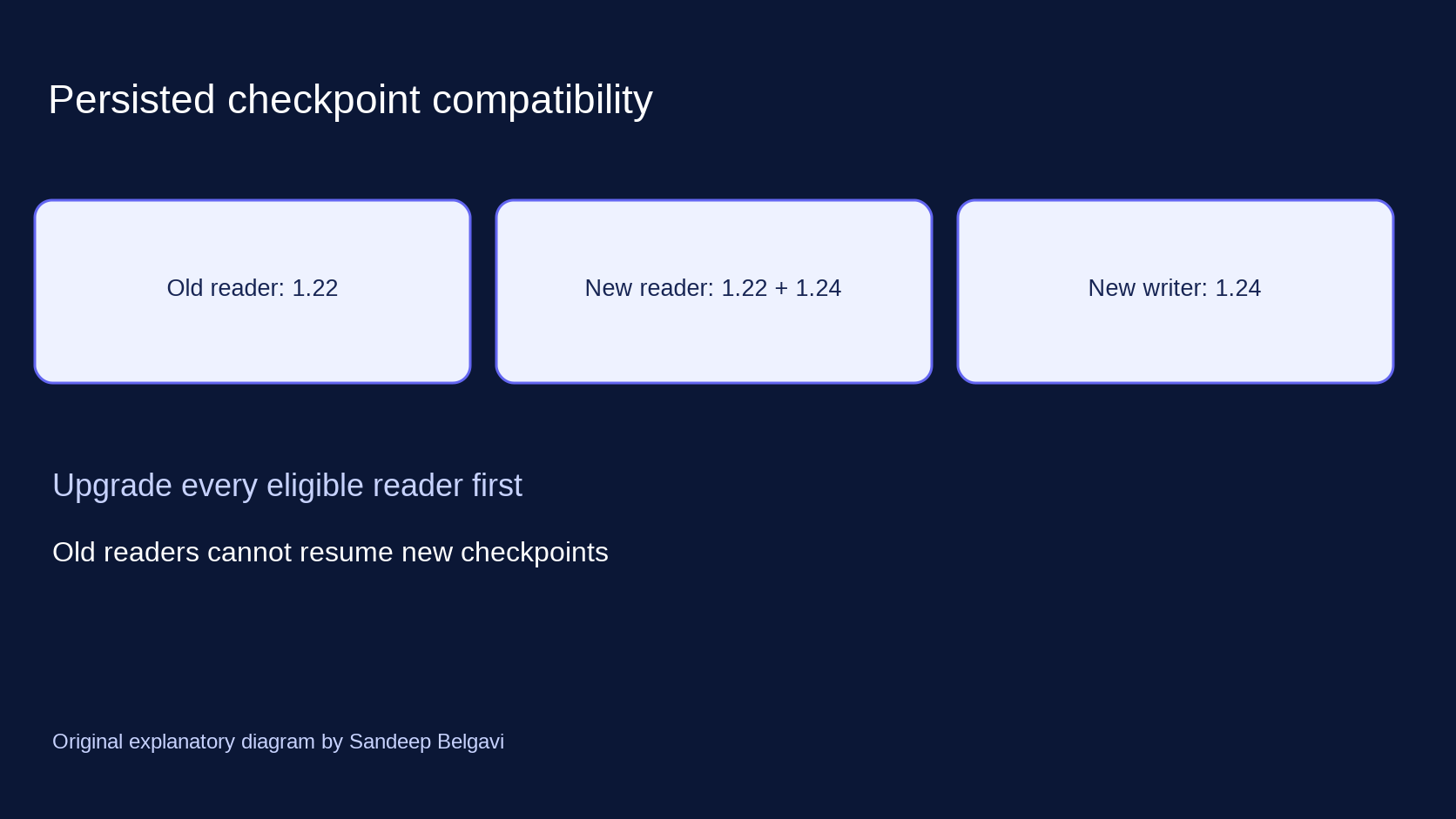
The November 23 UTC alpha.2 release changes persisted formats. Model mixed fleets, compatibility routing and rollback limits.
Persisted state survives the worker that wrote it
A rolling deployment is not only a conversation between old and new processes. It is also a conversation between those processes and state written earlier. A new worker can produce a checkpoint that an old worker cannot read. If requests move freely across a mixed fleet, an apparently successful upgrade can strand sessions when the next request lands on an older reader.
OpenAI Agents SDK 1.0.0-alpha.2 was published at 20:11 UTC on November 23, 2026, which was November 24 in India. Its release notes explicitly say to upgrade checkpoint readers before writers. Alpha.2 reads alpha.1 RunState schema 1.22 and always writes schema 1.24, even when redaction is disabled. Alpha.1 cannot read the new snapshots. Protected ResumableSession checkpoints use a separate version two format.
Those are release-specific facts, not a generic promise that every future version remains backward compatible. The release is a GitHub-only preview on a separate line from stable 0.26.0. This guide uses an original discrete-event model to explain deployment ordering. The model does not install the SDK, serialize its actual checkpoint format or recover a native process.
Draw the reader and writer compatibility matrix
Use two abstract formats in the lab: old and new. An old worker reads old and writes old. A new worker reads old and new and writes new. The important asymmetric cell is old-reader versus new-format, which is incompatible. A matrix makes this limitation visible before any rollout traffic is simulated.
Do not infer read compatibility from a version number comparison. Real systems can have capability flags, encryption envelopes, optional fields and incompatible semantic changes. Maintain an explicit tested reader-format relation. Also distinguish decoding a checkpoint from safely resuming its work: a reader may parse the bytes while lacking the tool declarations or authorization policy required to continue.
Treat the checkpoint format as a storage contract. Record the format version outside or in a safely readable envelope so routing can reject an incompatible reader before performing effects. Unknown formats should produce a clear unsupported-version outcome. Ignoring unknown fields is insufficient when those fields change the meaning of approvals, tool inputs or recovery state.
Walk through the mixed-fleet failure
Session S1 initially has an old checkpoint. A new worker reads it successfully and processes one turn. The worker writes a new checkpoint. A subsequent request for S1 lands on an old worker. That worker cannot read the checkpoint, even though the session was created before the deployment and the preceding turn succeeded.
Restarting the old worker does not help. Retrying randomly may eventually reach a new worker, but it turns a deterministic compatibility problem into an intermittent availability problem. A queue with old consumers can reproduce the same failure after the web fleet appears upgraded. Include background workers, recovery jobs and administrative readers in the inventory.
Now simulate readers-first deployment. Every possible reader is upgraded to accept both formats before any new-format write is admitted. Once the writer switch changes, every eligible worker can read what is produced. Existing old checkpoints can be migrated lazily as sessions resume. The safety condition is that the writer's possible outputs are a subset of every eligible reader's supported inputs.
A writer switch must actually exist
The generic expand-and-contract pattern often assumes a new binary can keep writing the old format during a reader rollout. That is not true for every SDK. Alpha.2's release notes say it always writes schema 1.24. Merely installing alpha.2 on some workers while letting all workers process turns therefore does not implement a separate reader-only phase.
One application strategy is to quiesce session writes, replace all eligible workers, verify their compatibility, then resume processing. Another is version-aware routing with isolated pools and a controlled migration boundary, provided old workers cannot receive migrated sessions. A third may require application-level adapters, but only if they are supported and tested; do not invent an old-format writer option that the release does not offer.
The lab's writer control models a deployment capability, not an SDK parameter. Its notes make that distinction explicit. If your real implementation cannot separate readers from writers, select a rollout protocol that respects that constraint. A diagram showing a switch is not evidence that the binary has one.
Preserve one writer and conditional persistence
Format compatibility does not prevent concurrent workers from overwriting each other's checkpoints. The release notes require atomic conditional writes for a custom ResumableSessionStore and one writer per session. An application-level revision or storage compare-and-swap operation detects a stale writer; a format version does not.
# Author: Sandeep Belgavi. Original compatibility admission example.
READS = {"old": {"old"}, "new": {"old", "new"}}

def admit_resume(worker, checkpoint_format):
    if checkpoint_format not in READS[worker]:
        return "route_to_compatible_reader"
    return "readable"

def writer_safe(format_to_write, eligible_readers):
    return all(format_to_write in READS[r] for r in eligible_readers)
This code checks a deployment invariant only. It neither locks sessions nor validates checkpoint contents. In a real store, write the next checkpoint only if the expected prior revision still matches. On conflict, discard the stale proposed state and reconcile according to the session protocol. Blind retry with an unconditional write can erase a newer approval or tool result.
Retain the original checkpoint for diagnosis according to storage policy, but do not make backup copies of sensitive state without the same protection and retention controls. A migration tool should identify its source revision and transformation version so rerunning it is auditable and idempotent.
Plan rollback around data already written
Before the first new-format checkpoint exists, rolling back binaries may be straightforward. After one is written, returning every worker to an old reader can break those sessions. A binary rollback is not automatically a data-format rollback. Keep compatible readers available or define a tested migration-back procedure where semantics permit one.
Some new state cannot be represented in the old format without losing meaning. Removing a field to make JSON parse is not a valid downgrade if the field binds an approval or protects a result. In that case, prefer forward repair or isolate affected sessions rather than silently discarding protection. The decision should be made before deployment pressure forces an improvised conversion.
Use metrics that count checkpoints by format and failed resumes by reason. A fleet percentage alone does not tell you whether old readers remain reachable or how much state has crossed the compatibility boundary. Track the first new-format write as an operational milestone because it changes the available rollback options.
Recovery is more than deserialization
The alpha.2 notes also describe restoring pending approvals with matching provider configuration, tool declarations, authorization policy and hooks. Recreated state does not grant broader authority than the original session had. The environment may need the same workspace path and unchanged affected files for supported native recovery. Treat those conditions as part of the resume contract.
The release notes warn that recovery cannot restart terminated commands and that partial external effects need reconciliation. A readable checkpoint can therefore still lead to a manual recovery outcome. The lab deliberately stops at format compatibility so it does not imply that a successful read means a safe continuation of every possible tool call.
Separate failures in reporting: unsupported format, revision conflict, missing tool, changed policy, environment mismatch and uncertain external effect. Combining all of them into checkpoint_error makes rollout diagnosis slower and encourages retries that cannot fix the underlying condition.
Test rollout order with an explicit trace
The lab uses a fixed sequence of sessions and worker assignments. Adjust the number of old readers, the writer format and whether routing checks compatibility. Each trace row records the selected reader, incoming format, read outcome and outgoing format. Reset returns to the documented mixed-fleet fixture; export saves the inputs and every transition.
Expected outcomes include an old checkpoint read by a new worker followed by a new checkpoint rejected by an old worker, an all-new reader fleet with successful new writes, and guarded routing that refuses an unsafe assignment before execution. Also test an attempted rollback after new-format state exists. These are deterministic fixture outcomes, not throughput or reliability measurements of the SDK.
Before a real rollout, run actual old and new binaries against disposable checkpoint fixtures, test recovery workers as well as request handlers, and verify conditional-store behavior. The essential ordering is simple to state but easy to violate: make every eligible reader compatible with the next writer format before allowing that format into durable state.
Interactive experiment
Checkpoint formats in a mixed fleet: readers first or writers first. Synthetic browser-local fixtures, adjustable inputs, decision traces and JSON export.
Run the example yourself
The synthetic fixtures, expected output and tests behind this guide are in the companion code on GitHub; its README lists the prerequisites, exact commands, expected output and limits.